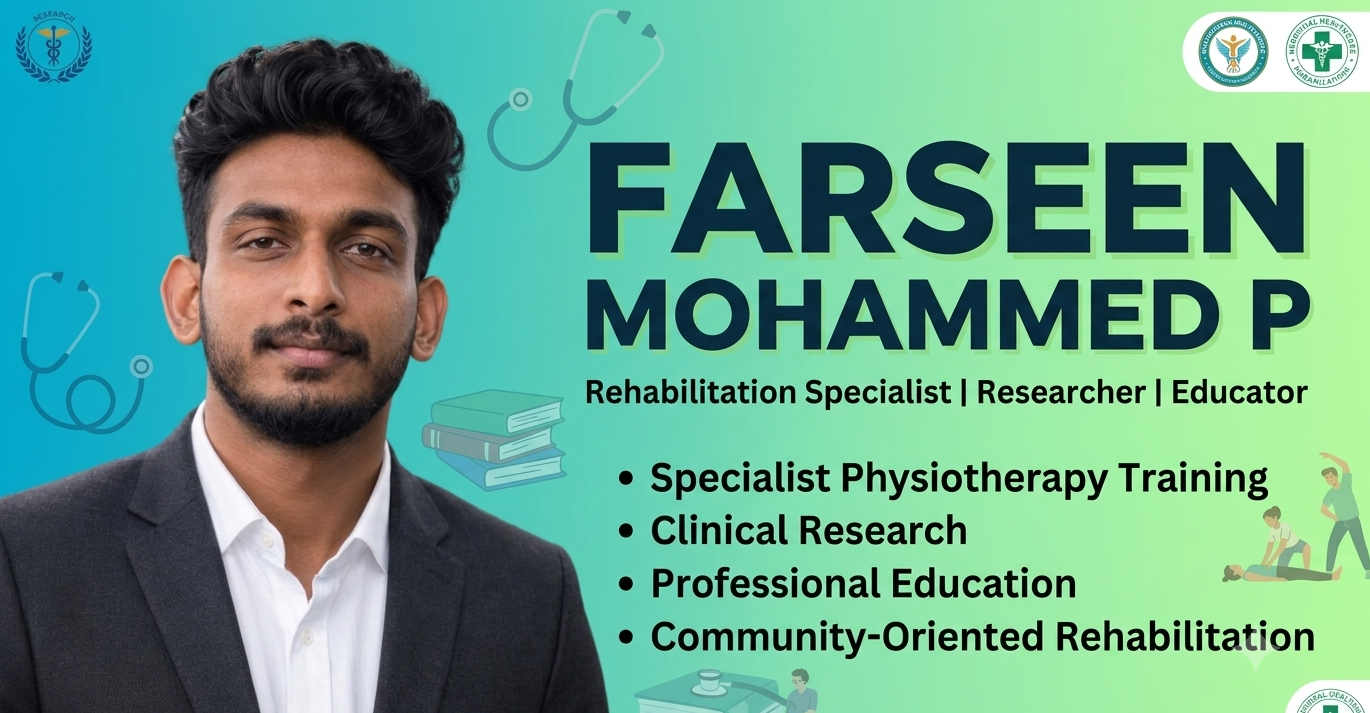
Mangaluru, Karnataka: A career in physiotherapy can develop through multiple interconnected stages, from clinical education and patient care to research, scientific communication and publication. For Farseen Mohammed P, the transition from clinical training to published research has become an important part of his professional development.
A specialist physiotherapist in neurosciences and clinical researcher, Farseen has built experience across neurological rehabilitation, therapeutic exercise, evidence synthesis and academic research.
Beginning With Clinical Physiotherapy Education
Farseen’s academic journey began with a Bachelor of Physiotherapy (BPT) from the Co-operative Institute of Health Sciences, Thalassery, affiliated with Kerala University of Health Sciences.
His undergraduate education provided a foundation in physiotherapy assessment, rehabilitation and clinical practice.
During this period, he also completed an undergraduate research project examining the prevalence of plantar fasciitis in women.
The project provided early exposure to clinical research and helped establish an academic interest that later developed further during his postgraduate education.
Moving Into Neuroscience Physiotherapy
Farseen subsequently pursued a Master of Physiotherapy in Neurosciences at Yenepoya Physiotherapy College, Yenepoya (Deemed to be University), Mangaluru.
His postgraduate specialization focused on neurophysiotherapy and neurorehabilitation.
The programme provided advanced academic and clinical exposure to neurological rehabilitation and conditions affecting movement and functional independence.
Clinical Training at Yenepoya Medical College Hospital
As part of his postgraduate development, Farseen gained clinical experience at Yenepoya Medical College Hospital, Mangaluru, from 2024 to 2026.
His neurological rehabilitation exposure included patients with stroke, Parkinson’s disease, traumatic brain injury, Guillain–Barré syndrome and spinal cord disorders.
He also developed experience with rehabilitation approaches such as Neurodevelopmental Treatment, Motor Relearning Programme and task-oriented training.
This clinical environment provided practical experience that could be connected with his emerging research interests.
Clinical Questions Leading to Research
Clinical experience can often generate questions about how rehabilitation interventions affect patient outcomes.
Farseen’s postgraduate dissertation focused on one such rehabilitation question:
“Effect of Eccentric Versus Concentric Strengthening on Functional Mobility in Subacute Stroke Patients: A Randomized Parallel-Group Comparative Study.”
The study examined strengthening approaches in relation to functional mobility following subacute stroke.
The project provided experience in clinical intervention research and contributed to his later academic presentations.
Presenting Research at Mangalore PhysioCon
Farseen presented his postgraduate research at Mangalore PhysioCon 2026.
His oral paper was titled:
“Effect of Eccentric Versus Concentric Strengthening on Functional Mobility in Subacute Stroke Patients.”
The conference took place on 10–11 April 2026 at the TMA Pai International Convention Centre in Mangaluru.
In addition to presenting research, Farseen served as an Organizing Member of the Scientific Committee.
The experience gave him exposure to both scientific communication and the organization of a professional academic event.
Developing Research Through Evidence Synthesis
Farseen’s research activities subsequently expanded beyond a single clinical study.
He developed interests in systematic reviews, scoping reviews and evidence synthesis.
One of his research projects examines the effectiveness of eccentric strengthening interventions on functional outcomes in adults after stroke.
The research builds upon his earlier clinical and postgraduate work in stroke rehabilitation while using evidence-synthesis methodology to examine a broader body of literature.
Recognition at SYNERGOS 2026
Farseen presented his systematic-review research at SYNERGOS 2026.
His presentation, titled:
“Effectiveness of Eccentric Strengthening Interventions in Stroke Rehabilitation: A Systematic Review,”
received the First Prize in the Postgraduate Category for Oral Paper Presentation.
The achievement represented an important milestone in his development as a researcher and scientific presenter.
Transition to Published Research
Farseen’s academic work also progressed from research presentations to peer-reviewed publication.
In 2026, he contributed to the scoping review:
“Timing of Dopaminergic Medication Relative to Physiotherapy Delivery in Adults with Parkinson’s Disease: A Scoping Review.”
The study was published in the International Journal of Drug Delivery Technology.
Farseen is listed as the second author and corresponding author.
The publication focuses on the relationship between dopaminergic medication timing and physiotherapy delivery in adults with Parkinson’s disease.
Expanding Research Beyond Stroke
Although stroke rehabilitation has been a major component of Farseen’s research interests, his academic work has expanded into other areas.
His research portfolio includes Parkinson’s disease rehabilitation, therapeutic exercise, cardiac rehabilitation and metabolic health.
Ongoing projects include research into exercise-based cardiac rehabilitation and exercise interventions for adults with metabolic dysfunction-associated steatotic liver disease.
This expansion demonstrates an interest in rehabilitation research across different clinical populations.
Building Research Methodology Skills
The transition from clinical training to research publication requires knowledge of research methodology.
To strengthen these skills, Farseen participated in a five-day hands-on international-level workshop on Systematic Review and Meta-Analysis conducted by IIRA, Mumbai, from 27 to 31 August 2026.
He has also undertaken training related to Indian Good Clinical Practice Guidelines.
These activities complement his clinical education by providing additional knowledge in research design, evidence evaluation and scientific methodology.
Research and Professional Development
Farseen’s research development has occurred alongside continuing professional education.
His additional qualifications and training include ACE Health Coach Certification, a postgraduate diploma in nutrition and specialized rehabilitation workshops.
His training has covered areas including stroke management, NDT, motor relearning and clinical research.
This combination gives his research development a clinical context.
Scientific Communication
Publishing research is only one part of academic development. Communicating research findings to professional audiences is another important skill.
Farseen has gained experience through oral presentations at professional physiotherapy conferences.
His participation in Mangalore PhysioCon and SYNERGOS has allowed him to present both clinical intervention research and evidence-synthesis research.
His role as a corresponding author on published research also adds an additional dimension to his academic communication experience.
Clinical Experience Supporting Research
Farseen’s clinical background remains an important component of his research profile.
Experience with neurological patients provides practical exposure to rehabilitation challenges, functional limitations and clinical decision-making.
This clinical foundation can help frame research questions around rehabilitation interventions and patient outcomes.
His professional interests therefore connect clinical experience with academic investigation rather than treating the two as separate career paths.
Continuing Research Activities
Farseen’s research journey remains ongoing.
His current portfolio includes systematic and scoping reviews covering stroke rehabilitation, motor learning, Parkinson’s disease, cardiac rehabilitation and metabolic health.
One ongoing scoping review examines tracking-based motor training for motor learning and functional recovery after stroke.
These projects indicate continued engagement with evidence synthesis and rehabilitation research.
From Student Researcher to Clinical Researcher
Farseen Mohammed P’s professional development demonstrates a gradual progression:
Undergraduate education introduced him to physiotherapy and clinical research.
Postgraduate specialization developed his expertise in neurosciences and neurorehabilitation.
Clinical training provided direct exposure to neurological rehabilitation.
Postgraduate research introduced clinical intervention research in stroke rehabilitation.
Conference presentations developed scientific communication skills.
Evidence-synthesis projects broadened his research perspective.
Published research marked an important step into academic contribution.
This progression reflects the development of a professional identity that combines clinical physiotherapy with research.
Looking Ahead
As Farseen Mohammed P continues developing his career, his combination of clinical experience and research training provides a foundation for further work in neurophysiotherapy and rehabilitation.
His published Parkinson’s disease research, ongoing stroke-related projects and broader interests in therapeutic exercise demonstrate an expanding academic direction.
The journey from clinical training to published research illustrates how physiotherapy professionals can develop beyond traditional clinical roles by engaging with scientific investigation, evidence synthesis and academic communication.
For Farseen, this progression represents an ongoing commitment to clinical learning, research development and evidence-based rehabilitation.
External links