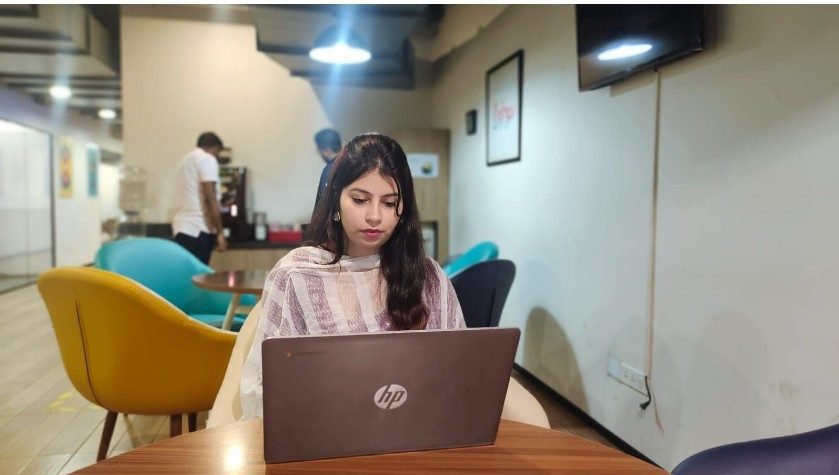
The employment market has two sides that depend on each other.
On one side are candidates looking for meaningful career opportunities.
On the other are companies searching for people with the right skills.
Yet despite this obvious connection, the two sides do not always meet effectively.
Preeti Sharma, founder of Nook & Hire, identified this disconnect and set out to create a technology-driven solution.
Launched in June 2025, Nook & Hire is an AI-powered HR-tech platform designed to connect candidate preparation, skill development, evaluation, matching, recruitment, background verification, payroll, and employee management.
Its broader objective is to build a stronger bridge between talent and opportunity.

Why the Gap Exists
The problem is not necessarily a lack of candidates.
India has a large and diverse talent pool.
The challenge is identifying which candidates are ready for which opportunities.
Candidates may have qualifications but lack interview preparation.
Employers may have open positions but struggle to find candidates with the right combination of skills and readiness.
Recruitment technology can help close this gap.
Candidates Need More Than Job Listings
A job listing tells candidates that an opportunity exists.
It does not necessarily tell them whether they are ready for that opportunity.
Candidates may need help with:
- Skill development
- Interview preparation
- Understanding employer expectations
- Presenting their experience
- Identifying relevant opportunities
Nook & Hire incorporates candidate preparation into its platform.
Employers Need More Than Resumes
Employers also need more than a collection of resumes.
They need to understand:
- What candidates can do
- Whether their skills fit the role
- How prepared they are
- Whether their experience is relevant
- How they perform during evaluation
AI-assisted screening and matching can help recruiters process this information more efficiently.
Building the Bridge
The concept behind Nook & Hire can be summarized as:
Candidate Preparation + AI + Structured Evaluation + Employer Requirements = Better Talent Alignment
Each component supports the others.
Preparation helps candidates become ready.
AI helps identify potential matches.
Evaluation helps employers assess candidates.
Structured workflows help move the process forward.

Candidate Preparation as the Starting Point
Instead of waiting for candidates to enter recruitment before supporting them, Nook & Hire focuses on preparation beforehand.
The platform includes interview-readiness programs and skill-development modules.
This can help candidates approach opportunities with greater confidence and readiness.
AI-Assisted Matching
Once candidates are prepared, the next challenge is connecting them with suitable opportunities.
AI can help analyze candidate profiles and role requirements.
This can identify potential matches that may otherwise require significant manual effort.
The objective is to make opportunity discovery more targeted.
Structured Evaluation
Matching alone cannot determine whether someone should be hired.
Evaluation remains an essential step.
A structured approach can help recruiters compare candidates more consistently.
It can also help hiring managers obtain better information before making decisions.

From Application to Employment
Nook & Hire’s model extends beyond the initial hiring decision.
The broader process can include:
Preparation
↓
Application
↓
AI-Assisted Matching
↓
Evaluation
↓
Recruitment
↓
Background Verification
↓
Payroll
↓
Employee Management
This creates a continuous connection between candidate and organization.
Preeti Sharma’s Founder Journey
Preeti Sharma approached recruitment as a system problem.
Her observation was that candidates and employers often have different expectations.
A candidate may believe qualifications should be enough.
An employer may need specific practical capabilities.
Her MBA from Ballari Institute of Technology & Management provided a business-focused perspective that contributed to her approach.
Nook & Hire was created to help address this alignment challenge.
The Importance of Employer Expectations
Candidates often prepare based on general assumptions.
But different industries and roles have different expectations.
A technology position may require one set of capabilities.
A sales role may require another.
An operations role may require something different again.
Structured preparation can help candidates understand these differences.
Helping Candidates Become Opportunity-Ready
The idea of opportunity readiness is central to modern employability.
A candidate can continuously improve:
- Technical skills
- Communication
- Interview performance
- Professional understanding
- Role-specific capabilities
This creates a stronger foundation for future applications.
Helping Employers Find Prepared Talent
Employers benefit when candidates understand professional expectations.
Recruiters can focus on evaluating relevant capabilities instead of spending excessive time addressing basic readiness issues.
This can make the hiring process more efficient.
The Role of AI in Bridging the Gap
AI can support the bridge in several ways.
Screening
Helping recruiters process candidate information.
Matching
Identifying potential alignment between candidates and roles.
Evaluation Support
Organizing relevant information for decision-makers.
Workflow Efficiency
Helping recruitment teams move through hiring stages.
Together, these capabilities can improve recruitment operations.
Why Human Interaction Still Matters
Technology can connect candidates and employers, but the final relationship remains human.
Candidates speak with recruiters.
Hiring managers conduct interviews.
Teams evaluate cultural and professional fit.
Organizations make decisions based on business needs.
AI supports this process but does not eliminate the need for human interaction.
Reducing Recruitment Friction
Recruitment friction can occur at many points.
Candidates may struggle to find relevant opportunities.
Recruiters may struggle to process applications.
Hiring managers may struggle to compare candidates.
HR teams may struggle with administrative coordination.
An integrated platform can potentially reduce friction across these stages.
India’s Talent Opportunity
India’s large workforce creates an enormous opportunity for better talent systems.
As companies expand, they need efficient recruitment infrastructure.
As professionals develop new skills, they need better ways to connect with employers.
Technology can help connect these two developments.
Building a Scalable Talent Ecosystem
A scalable talent platform needs to serve both sides of the market.
It needs to support candidates while also meeting employer requirements.
Nook & Hire’s model is designed around this dual objective.
Its future plans include industry expansion, stronger AI capabilities, enterprise partnerships, and improved candidate training.
The Future of Talent Connections
The future employment ecosystem may become increasingly connected.
Candidates may develop skills within the same ecosystem where they discover opportunities.
Employers may identify talent through AI-assisted systems.
Recruiters may manage hiring workflows through integrated platforms.
Employees may continue into payroll and employee-management systems without leaving the broader ecosystem.
Conclusion
The employment market does not simply need more candidates or more job openings.
It needs better connections between the two.
Preeti Sharma’s Nook & Hire is designed to build that connection by combining candidate preparation, skill development, AI-assisted matching, structured evaluation, recruitment, verification, payroll, and employee management.
Its approach reflects a broader shift in recruitment—from simply creating a marketplace for jobs to building an ecosystem for talent.
The ultimate goal is straightforward:
Help candidates become ready for opportunity, help employers discover relevant talent, and use technology to make the journey between the two more structured, efficient, and intelligent.

.jpeg "iPhone Repair in Noida at Apple Service Centre for Common Device Issues")