Get trusted autism care in Rourkela with a specialized child development clinic focused on improving your child’s overall growth. Our therapy programs address speech delay, behavioral challenges, and social interaction issues through structured and effective methods. With experienced professionals and a child-friendly approach, we help children build confidence and independence. Parents are actively involved to ensure consistent progress at home and in therapy sessions.

If you are searching for reliable autism treatment,
connect via WhatsApp at 9437164832 for expert guidance.
Autism and Slow Learning: Understanding Development Delays in Children
Autism and slow learning are often closely connected in the minds of parents who notice that their child is not developing skills at the same pace as others. It is natural for caregivers to feel concerned when a child takes longer to speak, understand instructions, or interact socially. However, it is important to understand that autism, or Autism Spectrum Disorder (ASD), does not mean a child cannot learn—it simply means they learn differently. The concept of “slow learning” in autism is not about lack of ability but about a unique pace and style of development that requires patience, structure, and the right support system.
Children with autism process information in a different way compared to typically developing children. This difference can affect how quickly they understand new concepts, respond to instructions, and develop skills. For example, a child with autism may need more time to grasp simple tasks like identifying objects, following directions, or forming sentences. This slower pace can sometimes be mistaken for a lack of intelligence, which is a misconception. In reality, many children with autism have strong abilities in specific areas such as visual learning, memory, music, mathematics, or pattern recognition. The key is to recognize these strengths and use them as a foundation for development rather than focusing only on delays.
One of the primary reasons behind slow learning in children with autism is difficulty in communication. Communication is the foundation of learning, and when a child struggles to understand or express language, it directly affects their ability to absorb information. A child may not fully understand verbal instructions, may require repetition, or may rely more on visual cues than spoken words. This does not mean the child is not learning; it simply means the method of teaching needs to be adapted. Using visual aids, gestures, and simple language can significantly improve understanding and help bridge the communication gap.
Another important factor is the way children with autism process sensory information. Many children experience sensory sensitivities, which can make it difficult to focus in certain environments. For example, a noisy classroom, bright lights, or unfamiliar textures can become overwhelming and distract the child from learning. In such situations, the child may appear inattentive or slow to respond, but the real issue is sensory overload. Creating a calm and structured environment can help reduce distractions and allow the child to focus better on learning tasks.
The need for routine and predictability also plays a role in learning speed. Children with autism often feel more comfortable when their daily activities follow a consistent pattern. Sudden changes or unexpected situations can cause anxiety, which may affect their ability to concentrate and learn. By maintaining a structured routine, parents and caregivers can create a sense of security that supports better learning. Simple practices such as fixed study times, consistent teaching methods, and clear expectations can make a significant difference in how effectively a child learns.
Repetition is another key element in understanding slow learning in autism. Children with autism often require repeated exposure to information before they fully understand and retain it. While this may seem time-consuming, repetition is actually a powerful learning tool. It helps strengthen memory, build confidence, and reinforce understanding. Parents should not feel discouraged if their child does not learn something immediately. Instead, consistent practice and gentle reinforcement can lead to steady progress over time.
Emotional factors also influence learning in children with autism. A child who feels stressed, anxious, or misunderstood may struggle to focus and engage in learning activities. On the other hand, a child who feels safe, supported, and encouraged is more likely to participate and make progress. This is why emotional support is just as important as educational strategies. Parents and caregivers should create a positive and nurturing environment where the child feels accepted and valued. Simple actions such as praising efforts, celebrating small achievements, and maintaining a calm attitude can boost the child’s confidence and motivation.
Another important aspect to consider is individualized learning. Every child with autism is unique, which means there is no one-size-fits-all approach to teaching. Some children may respond better to visual learning, while others may benefit from hands-on activities or structured routines. Understanding the child’s preferences and adapting teaching methods accordingly can greatly improve learning outcomes. For example, if a child shows interest in numbers or patterns, those interests can be used to introduce new concepts in a way that feels engaging and familiar.
Professional therapies can also play a crucial role in supporting children with autism and slow learning. Speech therapy helps improve communication skills, making it easier for the child to understand and express ideas. Occupational therapy focuses on developing daily living skills and improving coordination, while behavioral therapy helps manage attention, behavior, and social interaction. These therapies are most effective when started early and combined with consistent support at home. Parents should actively participate in the process, as continuity between therapy sessions and home environment enhances overall progress.
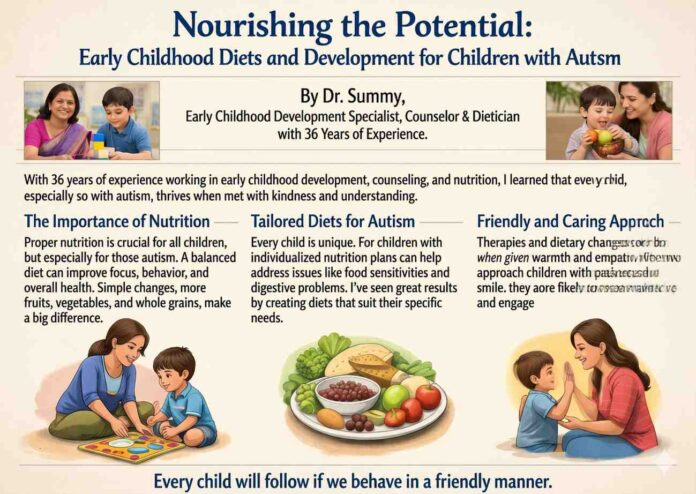
In addition to therapy, lifestyle factors such as nutrition, sleep, and physical activity contribute to a child’s ability to learn. A balanced diet provides essential nutrients that support brain function, while proper sleep helps improve concentration and memory. Physical activity, even in simple forms like playing or walking, can reduce stress and improve overall well-being. Maintaining a healthy routine ensures that the child is physically and mentally prepared for learning activities.
Parents often feel worried or frustrated when they compare their child’s progress with others. It is important to remember that comparison can create unnecessary pressure and negativity. Every child develops at their own pace, and progress should be measured based on individual growth rather than external standards. A child who learns slowly but steadily is still making meaningful progress. Focusing on small achievements and consistent improvement is more beneficial than expecting rapid results.

If parents notice significant delays or challenges in their child’s development, seeking professional guidance is an important step. Early intervention can help identify specific needs and provide targeted support, making it easier for the child to develop essential skills. For guidance or to share patient details, you can connect via WhatsApp at 9437164832.
In conclusion, autism and slow learning should not be viewed as limitations but as differences in the way a child learns and experiences the world. With the right approach, patience, and support, children with autism can develop skills, build confidence, and achieve meaningful progress. Understanding their unique learning style, providing a structured environment, and offering consistent emotional support can make a significant difference in their journey. Progress may be gradual, but every step forward is valuable, and with time, dedication, and care, children with autism can reach their full potential and lead fulfilling lives.